
Card Payment ACH Payment
Skip to main content

All About Plumbing, HVAC, Septic, and Electric

What Should I Know About Electric Water Heater Repair?

How Do You Troubleshoot an Electric Water Heater?

If your electric water heater is malfunctioning, it’s a problem. The first thing homeowners are advised to do is turn off the power. Safety comes first. You can do this by turning off the fuse or circuit breaker connected to the heater unit. The next thing to know is that a few types of electric water heater issues can cause water temperature issues. The problem could be that there is no power, a faulty electric thermostat or a faulty upper electric heating element. The first thing to do is to rule out any power issues. Reset any tripped breaker and replace any blown fuses. The next thing to do is check if power is being channeled to the electric water heating element thermostat. Check this element, and if it is malfunctioning, please replace it. If the thermostat is receiving power but still isn’t working, you can replace it or the electric water heating element.

How Do You Reset an Electric Water Heater?

There are a few reasons why a person would want to reset their electric water heater. If your water heater is displaying symptoms of not heating water, or low functionality, resetting the water heater may fix the problem. The first thing that you should check is the water heater’s heat switch. This is usually a red button located on the upper thermostat of an electric water heater. The panel will need to be removed to access it. If the button is alight, it means that the switch was tripped. It will need to be reset. You can reset the water heater by pressing the red button.

How Much Does it Cost to Fix a Hot Water Heater?

On average, the cost to repair a broken water heater is approximately $483. Many homeowners tend to pay between $244 and $576 to have their hot water heaters repaired. There is a great guideline to contemplate when debating whether or not to repair or replace. Never spend more than half the cost of replacing a water heater on the repair. If a new water heater costs $850, which is the average cost, it makes sense to replace the water heater if your bill is $600.

How Long do Electric Water Heaters Last?

Electric water heaters last approximately ten to fifteen years. Electric water heaters have a longer life expectancy than gas water heaters, which tend to last eight to twelve years on average.

Are Electric Water Heaters Good?

Heating water is the second-largest expense in the home, accounting for usually fourteen to eighteen percent of utility bills. With this in mind, it’s important to consider the operating cost of your water heater. Electric water heaters run on electricity, rather than gas. Typically, electricity is more expensive than gas, depending on where you live. While electric water heaters cost more to operate, they also last longer than gas water heaters. At the end of the day, both gas and electric water heaters are good. The choice depends on personal preference.

Electric Water Heater Repair

Before embarking on a DIY water heater repair, consider safety precautions first. Safety precautions include making sure the electricity is turned off before you attempt any fixes. Make sure you have researched the inner mechanisms of your water heater. If you need tools for the task, make sure to purchase them ahead of time. If you don’t have the time or expertise, please be sure to consult a reputable plumbing company that specializes in electric water heater repair. Home improvement projects, like electric water heater repair, need to be addressed as soon as possible. This is because your hot water needs are important. Just like your plumbing, your roof is important. For roof installation in High Point, NC, select a roofing company you can trust.

Electric Water Heater Repair or Replace

As previously mentioned, electric water heater repair can be expensive. Homeowners who are facing an expensive water heater repair bill may rightfully decide to replace rather than repair their water heater. Please consider the following additional reasons why you should replace your water heater.

  • Old age. Electric water heaters have a life expectancy of ten to fifteen years. If your electric water heater is older than fifteen years of age and needs repair, it’s a good idea to replace your unit.
  • Rusty water. Rusty water is a very bad sign. It means that your water heater has accumulated sediment at the bottom of the tank. Please mention this to your plumber
  • Odd sounds coming from your water heater. Odd sounds are another problematic sign for your water heater. Please get the sounds diagnosed immediately.
  • Pools of water around the water heater. Not only are pools of water a sign of a potentially broken water heater, but it’s also a safety hazard.

Electric Water Heater Repair Service

If water heater service is required, please contact a respectable local plumber in your area. There are many certifications that allow plumbers to achieve high rankings in the plumbing industry. A master plumber, for instance, has passed numerous certification tests and has many years of experience. While not all plumbers search out such certifications, it’s important to note that a more experienced plumber will have more knowledge about your electric water heater.

Just like water heaters, HVAC equipment such as furnaces and heat pumps can be dangerous to troubleshoot without proper training. If you suspect a heating issue, it’s safest to have a licensed technician diagnose the problem. Visit our Emergency HVAC Repair page for guidance on what to do next.

Electric Water Heater Repair Parts

There are many electric water heater parts and accessories. An electric water heater will require different parts than a gas heater. Your local, experienced plumber will most likely have all of these parts available, or they will order a specific part for you depending on the type of repair.

With many years of experience, All About Plumbing & Septic  is uniquely qualified to repair your electric water heater. Call us today at 828-581-4073 for your electric water heater repair in Hendersonville, Mills River and Asheville, NC.

How Can You Tell if You Have a Gas Leak in Your House?

Natural gas plays an essential role in the lives of American homeowners. It fuels our cooking appliances, powers our hot water heaters, and energizes our furnaces during the cold winter months. Many people forget about the toxic, lethal nature of this substance. When the gas lines spring a leak, it puts your family and home at risk.

Today, we’re going to talk about leaks and gas line repair in house. By the end, you should have a firm understanding of how to respond in the event of leak. Let’s get started!

What Happens With a Gas Leak?

Gas leaks may pop up as the result of long-term pipe or hose degradation. Some homeowners accidentally create their own leaks when they tinker with their gas appliances. Whatever the cause, the results can be disastrous! In the United States, these leaks produce household fires and explosions. Natural gas leaks and subsequent carbon monoxide creation also cause a handful of deaths every year.

Thankfully, most homeowners know the signs of a potential gas leak and quickly call for help. We’ll discuss how you can identify leaks in your gas line and appliances.

Warning Signs

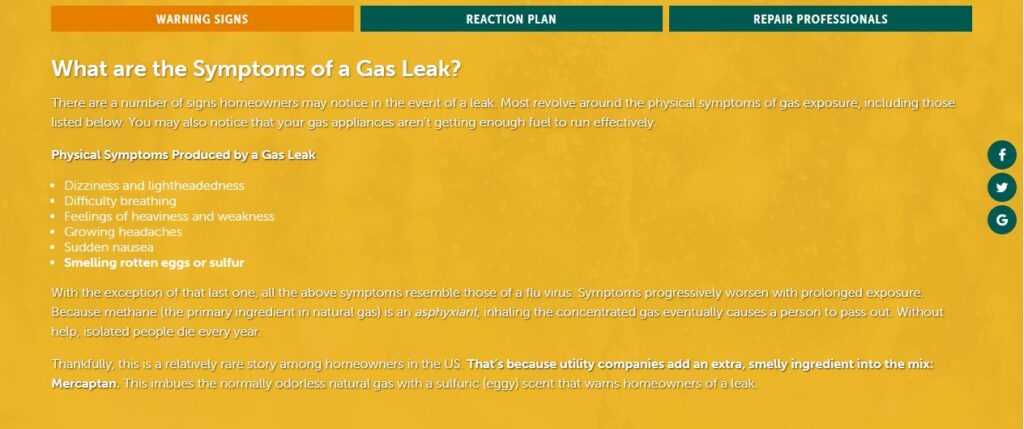
What are the Symptoms of a Gas Leak?

There are a number of signs homeowners may notice in the event of a leak. Most revolve around the physical symptoms of gas exposure, including those listed below. You may also notice that your gas appliances aren’t getting enough fuel to run effectively.

Physical Symptoms Produced by a Gas Leak

  • Dizziness and lightheadedness
  • Difficulty breathing
  • Feelings of heaviness and weakness
  • Growing headaches
  • Sudden nausea
  • Smelling rotten eggs or sulfur

With the exception of that last one, all the above symptoms resemble those of a flu virus. Symptoms progressively worsen with prolonged exposure. Because methane (the primary ingredient in natural gas) is an asphyxiant, inhaling the concentrated gas eventually causes a person to pass out. Without help, isolated people die every year.

Thankfully, this is a relatively rare story among homeowners in the US. That’s because utility companies add an extra, smelly ingredient into the mix: Mercaptan. This imbues the normally odorless natural gas with a sulfuric (eggy) scent that warns homeowners of a leak.

Reaction Plan

What Do You Do if You Suspect a Gas Leak?

The first thing you need to do is warn everyone else in your home about the leak. Don’t use any electric appliances, as concentrated natural gas may be ignited by any electrical sparks. Turn off all gas appliances in your home and call your gas company as soon as possible.

You’ll also need to arrange testing and potential repairs for your gas line. This isn’t something you can delay. For other issues, say roofing damage, you could wait for a highly-rated High Point, NC residential roofing company to drive all the way out to your home. For gas leaks however, you’ll want immediate assistance from someone local.

Repair Professionals

Do Plumbers Repair Gas Lines?

Yes! Homeowners should always have their gas line repair and installation handled by a seasoned professional. Many plumbers are qualified to handle your gas line repair, though you will need to confirm the leak before repairs can start (obviously). That’s another reason to call your plumber as soon as possible.

How Do Plumbers Check for Gas Leaks?

Plumbers utilize specially equipment for sniffing out leaks. They isolate the leak to the individual fitting or degraded piping. After turning off the gas, they can replace the damaged piping. Finally, they test your system to make sure it’s functioning correctly.

Who is Responsible for Gas line Repair?

Ownership of the gas system is separated by a crucial boundary: the meter. On the street side of your meter, the utilities company is responsible for repairs and maintenance. On the home side of the meter (including the underground line), your family assumes gas line repair responsibility. That’s one more reason to never go poking around in the yard without consulting your utilities company!

Many families mistakenly assume that management of the gas line falls to the gas company. They receive quite the shock if they have to replace their gas line, a project that can run in the thousands. Thankfully, most gas line problems occur due to loose fittings and connections, which are relatively cheaper to fix.

Gas leaks inside a home aren’t always tied to water heaters or kitchen appliances. In some cases, the source can be a malfunctioning gas furnace, especially if the system has damaged valves, cracked heat exchangers, or aging connections. If you suspect the issue may involve your heating system, have it inspected immediately by our sister company

Find Your Gas Line Repair!

Remember, fixing a leak is serious business. For the safety of your family and home, make sure you call a plumber who is certified to handle gas line repair in Hendersonville, Mills River and Asheville, NC. Our seasoned professionals at All About Plumbing & Septic would be happy to help you resolve this scary situation. To arrange your plumbing services in Asheville, NC or a nearby city, call our friendly staff at 828-552-5721! We can’t wait to serve you.
Signs of Poorly Vented Plumbing Drain Lines

Pay Attention to the Signs

Have you ever been in your bathroom and seen air bubbles rising through your toilet bowl? Have you noticed the water rising and falling randomly? If these things are occurring when you aren’t flushing the toilet, you likely have a clogged toilet. Also called an “improperly vented toilet,” this type of thing occurs when you’ve got an appliance like a washing machine nearby and your toilet isn’t getting enough air.


How Pipes Work

Pay Attention to the Signs of Poorly Vented Plumbing Drain Lines All pipes need to “breathe.” Most drain pipes use the principal of gravity to send water down drain lines. As wastewater moves through your pipes, the pipe’s air pressure fluctuates. For this reason, most pipes have vertical vents that let air into the pipe that they can “breathe.” When pipes breathe, they let air in so it can water and flow and work property.

If this sounds a bit confusing, think for a moment about pouring water from a can with only one opening. Whenever you pour liquid this can, you’ll notice that the water doesn’t flow evenly. However, if you add a second opening to this can, water will more easily flow out of the can when you pour it out. The principle same is true when we talk about plumbing. As water goes down a drain, air is needed to equalize the pressure in the drain line.

Sign’s of Poorly Vented Drain Lines

Do you know if you have a poorly vented drain line? Here are 5 signs to look out for:

Methane Odor – If you smell a strong methane odor coming from your drain or toilet, this usually means that you’ve got poorly vented drain lines. In a normal properly functioning plumbing system, a seal prevents outside harmful gases from entering your house. When you’ve got poorly vented drain lines, your pipes become empty and start drying out. This allows the seal to be broken and harmful gases to start to enter your home. Always call a plumber if you smell a harmful odor like Methane near your toilets.

Bubbling Toilet – If you see bubbles in your toilet happening at any other time then when you’re flushing, you’ve likely got a situation where a blocked vent is creating pressure in your pipes and forcing air up the pipes into your toilet bowl.

An Empty Toilet – If your toilet bowl doesn’t automatically refill with clean water when you flush it, this means that there isn’t any water in the pipes or the reserve behind your toilet. Pipes require air pressure to keep water in this reserve. A poorly vented drain line doesn’t have air pressure, so water flows down the pipes away from your toilet.

Gurgling Toilet – If you hear noise coming from your pipes after you flush, you’ve probably got poorly ventured drain lines. In this case, the gurgling sound happens when water can’t go down the pipe easily because of less air in the pipes.

Slow Drains – A slow drain either happens from a clog or a plugged vent. If your pipes don’t have the right ventilation to push water down the pipes, it will drain slowly or not drain at all.

The Solution

Since pipes need to breathe, any type of drain line that is poorly vented can be a serious problem and affect your plumbing. This type of situation isn’t any easy “DIY” fix because the solution means removing walls to examine your drain system. Regardless of the cause, a poorly vented drain line can cause a multitude of problems. Unless you know what you’re doing, it’s much better to call a professional plumber to fix the job at 828-552-5721.

Pay Attention to the Signs

Have you ever been in your bathroom and seen air bubbles rising through your toilet bowl? Have you noticed the water rising and falling randomly? If these things are occurring when you aren’t flushing the toilet, you likely have a clogged toilet. Also called an “improperly vented toilet,” this type of thing occurs when you’ve got an appliance like a washing machine nearby and your toilet isn’t getting enough air.

How Pipes Work

Pay Attention to the Signs of Poorly Vented Plumbing Drain Lines All pipes need to “breathe.” Most drain pipes use the principal of gravity to send water down drain lines. As wastewater moves through your pipes, the pipe’s air pressure fluctuates. For this reason, most pipes have vertical vents that let air into the pipe that they can “breathe.” When pipes breathe, they let air in so it can water and flow and work property.

If this sounds a bit confusing, think for a moment about pouring water from a can with only one opening. Whenever you pour liquid this can, you’ll notice that the water doesn’t flow evenly. However, if you add a second opening to this can, water will more easily flow out of the can when you pour it out. The principle same is true when we talk about plumbing. As water goes down a drain, air is needed to equalize the pressure in the drain line.

Sign’s of Poorly Vented Drain Lines

Do you know if you have a poorly vented drain line? Here are 5 signs to look out for:

Methane Odor – If you smell a strong methane odor coming from your drain or toilet, this usually means that you’ve got poorly vented drain lines. In a normal properly functioning plumbing system, a seal prevents outside harmful gases from entering your house. When you’ve got poorly vented drain lines, your pipes become empty and start drying out. This allows the seal to be broken and harmful gases to start to enter your home. Always call a plumber if you smell a harmful odor like Methane near your toilets.

Bubbling Toilet – If you see bubbles in your toilet happening at any other time then when you’re flushing, you’ve likely got a situation where a blocked vent is creating pressure in your pipes and forcing air up the pipes into your toilet bowl.

An Empty Toilet – If your toilet bowl doesn’t automatically refill with clean water when you flush it, this means that there isn’t any water in the pipes or the reserve behind your toilet. Pipes require air pressure to keep water in this reserve. A poorly vented drain line doesn’t have air pressure, so water flows down the pipes away from your toilet.

Gurgling Toilet – If you hear noise coming from your pipes after you flush, you’ve probably got poorly ventured drain lines. In this case, the gurgling sound happens when water can’t go down the pipe easily because of less air in the pipes.

Slow Drains – A slow drain either happens from a clog or a plugged vent. If your pipes don’t have the right ventilation to push water down the pipes, it will drain slowly or not drain at all.

The Solution

Since pipes need to breathe, any type of drain line that is poorly vented can be a serious problem and affect your plumbing. This type of situation isn’t any easy “DIY” fix because the solution means removing walls to examine your drain system. Regardless of the cause, a poorly vented drain line can cause a multitude of problems. Unless you know what you’re doing, it’s much better to call a professional plumber to fix the job at 828-552-5721.

Hot Water Heaters Part 2: Tankless Water Heaters

When it is time to replace your water heater, tankless water heaters are an upgrade worth giving serious consideration. They have great benefits and are a fast-growing favorite these days. We’ve included some pros and cons to help you make this decision, as well as tidbits about picking the right plumber.

Pros

Unlimited hot water – Running out of hot water is a nuisance. Unlike traditional water heaters, tankless units don’t store a limited amount of hot water. Instead, they heat the water as you use it. They typically heat two or three gallons of water per minute, and on demand. If you often run out of hot water with a traditional water heater, this is a better solution.

Save money – If you typically use less than 41 gallons of hot water daily, tankless heaters can save you as much as 34% in energy bills, or about $100/yr. Tankless units don’t use as much energy because they don’t have to maintain water temperatures even if you aren’t using hot water, a definite advantage over traditional ones. Tankless water heaters also have a much longer lifespan over traditional water heaters, about twice as long. This saves you money in the long run.

Save space – Tankless water heaters are small and take up mere inches on a wall instead of an entire closet.

Cons

Is Your Water Heater Working Properly? Give Us a Call!

Initially, more expensive – Tankless units are a more expensive to install, so if you are living on a tight budget, this could be an issue. It depends on the model, of course. If you are replacing a traditional water heater with a tankless one, there will be additional retrofitting expenses because the tankless system is more complicated.

Plumber Tips

If you frequently run out of hot water, a tankless water heating system is probably your best bet. Any reputable (and licensed) plumbing service can handle that, but don’t overlook the extras that say the company will go the extra mile for you, such as being able to talk to a real person instead of a machine or answering service when you call.

All About Plumbing and Septic, of Asheville, NC, cares about you, which is why we offer same day and emergency service and want to help you save money with a $25 coupon on our website for first-time clients. Give us a call today for more information. Chances are, if you call during the day, you’ll almost always get an owner! Here’s our number, 828-552-5721, give us a ring, today!

Hot Water Heaters Part 1: Traditional Water Heaters

Do you need a hot water heater? Chances are, traditional hot water heaters with standard plumbing is right for you. Here are some tips to help you decide, as well as what to look for in plumbing services. (Tankless water heaters will be covered in another article.) Once you have decided if traditional heaters are for you, then you’ll need to enlist the aid of an affordable plumbing service, because installing water heaters is not usually something you would want to do yourself.

Pros

Convenience – Traditional water heaters preheat and store the hot water, which is available any time someone showers or washes dishes or laundry. They automatically refill and reheat water.

Simplicity – They have a much lower installation cost than tankless heaters, and because installation is easy (therefore easy to replace), there’s not much can go wrong if you are a DIY fan.

Cons

Limited hot water – Traditional tanks usually hold 30-50 gallons of water, which might not be enough for your needs any particular day. If you’ve ever jumped in the shower after a teenage daughter, only to discover she used all the hot water, you know what we mean.

Higher utility expense – Despite cheaper installation cost, traditional water heaters have a higher utility cost over the lifetime of the tank because it heats and maintains that temperature (reheats the water as needed) whether or not you use the water. It eventually adds up.

Shorter lifespan – Most of these tanks last maybe 15 years. That’s about half as long as tankless heaters.

Picking a Plumber

If a traditional water heater seems right for you and your family, the next step is to find an affordable plumbing service. Any plumber can handle standard plumbing issues like this, and should obviously be licensed, so consider amenities like same day service and emergency service. All About Plumbing & Septic of Hendersonville, Mills River and Asheville, NC is such a company. We offer $50 coupons on our website for hot water services and carry all types of traditional, gas, electric, oil and tankless heaters in stock. We believe in going the extra mile for our customers, which is why there is a technician on call 24/7. Check out our website for more information or call us at 828-552-5721.

Learning How to Avert Major Plumbing Issues

Plumbing has been with us since way back in the Roman times, but much has changed between then and now. Today’s modern homes come equipped with luxurious hot and cold water throughout. Plumbing is great when it works, but when it fails, the house can turn into a horrible, soggy mess. The best thing to do is to be on the lookout for plumbing issues ahead of time so that you don’t have a bad situation on your hands.

Keeping an Eye Out for Plumbing Issues

Savvy homeowners are good at finding ways to deal with small plumbing issues before they become big plumbing problems. Help your plumbing remain dry and happy with these ideas:

  • Watch out for trouble. With plumbing, always remember that little leakages can quickly become big plumbing problems. Look out for any sign of an impending plumbing failure: damp cabinets, rocking toilets, leaking faucets, or leaking fridges all are serious issues that need to be quickly addressed.
  • Quickly repair problems. You don’t want ignore a dripping faucet. Why? Because a dripping faucet is extra moisture that puts wear on sink components. This extra moisture can quickly cause the growth of mold and mildew. Watch out for these types of issues to keep the home dry.
  • Find your home’s primary shut-off valve. Imagine a worst-case scenario where you’ve got water pouring down your stairs in the basement from a damaged pipeline…and you don’t know where your water shut-off valve is. This is why you should find your shut-off valve before you have an emergency.
  • Know your appliances. Make sure you know how to turn off water going to sinks, toilets, washing machines, and the fridge’s ice maker. Knowing this is crucial for addressing leaks and other situations that could suddenly arise.
  • Find your drain valve. Search for your home’s primary sewer valve. This is a valve that gives access to a clogged sewer line. Knowing the valve’s location is helpful when toilets are overflowing.
  • Use your tools: With just a few tools and a little knowledge, most of us can learn how to handle small plumbing problems. You just need to add a pipeline wrench, a plunger, and a sewage system snake to your tool kit. These tools will allow you to take care of small problems like blocked drain pipes, blocked toilets, stuck valves, and dripping faucets.

Be Ready for Cold Snaps

In the dead of cold winter nights, freezing pipes can create serious emergencies. Why? When water freezes, it expands pipes, which can cause pipelines to crack. When the area warms up, the pipelines burst and water goes everywhere. Frozen water expands, cracking pipelines; when the area defrosts, water bursts through the cracks, potentially flooding your house. Don’t let this happen to you! Try these suggestions:

  • Use insulation to prevent frozen pipes. What you can do is insulate exposed pipes in a crawl space or basement with specialized, easy-to-install plastic insulation. This special insulation is a peel-and-stick solution that can be purchased at your local Lowe’s or Home Depot, peeled off, and stuck right on the pipes.
  • Winterize your house. Before the onset of winter, disconnect your outside houses and apply insulating caps to outdoor fixtures. A frozen exterior spigot can damage interior pipes.
  • Snap into action during a cold snap. As soon as the cold front moves in, snap into action and open cabinets beneath sinks and bathroom fixtures, set up radiator heaters in your garage, and open up taps to a bare trickle (keeps water flowing and prevents a frozen blockage). Warmer household air will help prevent the pipes inside from freezing.
  • Don’t panic if pipes freeze. The first thing you need to do is shut off your water supply to your house (using your water shut-off valve). Then, open a faucet near the blocked area to vent vapors from the frozen water. If you think your hot water pipes are frozen, go ahead and turn off the hot water heater. Use a hair dryer to warm the frozen pipe, starting at the end of the pipe nearest to the tap. You’ll know the pipe has begun to thaw when water begins to trickle from the open faucet. When the flow is restored, check the plumbing carefully for cracks or leaks.

How to Maintain Your Water Conditioning Systems

In areas that have hard-water areas, water softeners are great because they condition water to remove unwanted minerals. The thing about softened water is that it extends the life of appliances, uses less soap, and prevents mineral buildup in pipes.

Keep your water conditioning system running with good maintenance. Many models have a salt-exchange method that requires a steady supply of salt nuggets. Check the manufacturer’s requirement and use the salt recommended by them. Keep an eye on the brine tank to make sure that the salt levels are high enough over the water line. If you see a crust of salt that forms over the top of the brine tank, break it up by poking the crust with a broomstick or adding hot water to the tank.

After being used for a while, water softeners will need to recharge: The unit will flush collection areas of accumulated mineral particles pulled from hard water. If your unit requires manual recharging, stick carefully to the manufacturer’s recommended time intervals. If your unit offers an automatic regeneration scheduling, use it — you’ll have soft water automatically.

Reducing Water Usage in Your Household

These days, being a sustainable household means conserving water. Try these suggestions to lower water use at your house:

  • Use the dishwasher. Hand-washing dishes actually wastes a lot of water. Automatic dishwashers use less hot water and energy than washing by hand. Also, most modern dishwashers are designed to remove food and grease without you having to pre-wash or pre-rinse the dishes.
  • Use low-flow toilets. Replace older toilets with newer low-flow toilets, which use less water.
  • Take short showers. Keep your showers short to save water and money. Also, you can install a low-flow showerhead. These shower heads use about 50 percent less water than older models.

Contact All About Plumbing & Septic for Major Plumbing Issues

Even when you keep up with plumbing maintenance, issues still sometimes occur.  When you have an issue that you can’t easily solve yourself, you can trust the experts at All About Plumbing & Septic to help.  Contact us to schedule an appointment.

When Should I Pump My Septic Tank?

You flush your toilet, and the water rises. You try again, and it goes even harder. You know better than to try a third time and risk overflowing the toilet. A clogged toilet is a pain, but it’s certainly easy to remedy. If the steps below don’t fix your problem, you may have a larger issue that requires the expertise of a plumber. Here’s how to fix a clogged toilet.

Don’t Flush a Clogged Toilet

Toilets don’t unclog by repeated flushing. Doing so will just make things worse. Until you actually are making demonstrable progress with your unclogging efforts, you should not touch the flusher.

Determine the Cause of the Clog

You don’t properly appreciate a toilet until it stops working. A clog doesn’t happen for no reason. They happen when a toilet is forced to take in more than it can handle or items that were never meant to be flushed. You obviously shouldn’t flush a pen or a toy down the toilet. But you also shouldn’t flush things like paper towels or diapers. Additionally, using too much toilet paper can clog your toilet fast. It’s not too difficult to fix, but it’s much easier to avoid a clog in the first place by flushing with more discretion.

Plunge Away

If you don’t have a plunger, go get one right now. It doesn’t matter whether or not your toilet is clogged. You need to have to have a plunger (or failing that, a toilet snake) to get rid of clogs as quickly as possible. When you retrieve your plunger, get it loose with some high-temperature water.

Get it deep into your toilet and plunge with purpose. Use a consistent rhythm that’s strong but also loose enough to make sure that your plunger is able to move. As you continue, you should see and hear your toilet cooperating. The water should start to recede. When you feel ready, you can flush. If it flushes smoothly, you’re good to go. Should the water rise or not do anything, you might need to plunge more.

Avoid Future Clogs

It’s not difficult to not clog a toilet. Just make sure you don’t flush anything that doesn’t belong. You can easily find a list of things that shouldn’t be flushed. Print it out and put it up to inform your family and guests.

If your toilet won’t unclog after repeated effort, it’s time to find professional help. The team at All About Plumbing & Septic will be more than happy to help you with unclogging your toilet and any other plumbing problems you might be having with your pipes and drains. Please give us a call today at 828-552-5721 so we can schedule a visit.

How to Fix a Clogged Toilet

You flush your toilet, and the water rises. You try again, and it goes even harder. You know better than to try a third time and risk overflowing the toilet. A clogged toilet is a pain, but it’s certainly easy to remedy. If the steps below don’t fix your problem, you may have a larger issue that requires the expertise of a plumber. Here’s how to fix a clogged toilet.

Don’t Flush a Clogged Toilet

Toilets don’t unclog by repeated flushing. Doing so will just make things worse. Until you actually are making demonstrable progress with your unclogging efforts, you should not touch the flusher.

Determine the Cause of the Clog

You don’t properly appreciate a toilet until it stops working. A clog doesn’t happen for no reason. They happen when a toilet is forced to take in more than it can handle or items that were never meant to be flushed. You obviously shouldn’t flush a pen or a toy down the toilet. But you also shouldn’t flush things like paper towels or diapers. Additionally, using too much toilet paper can clog your toilet fast. It’s not too difficult to fix, but it’s much easier to avoid a clog in the first place by flushing with more discretion.

Plunge Away

If you don’t have a plunger, go get one right now. It doesn’t matter whether or not your toilet is clogged. You need to have to have a plunger (or failing that, a toilet snake) to get rid of clogs as quickly as possible. When you retrieve your plunger, get it loose with some high-temperature water.

Get it deep into your toilet and plunge with purpose. Use a consistent rhythm that’s strong but also loose enough to make sure that your plunger is able to move. As you continue, you should see and hear your toilet cooperating. The water should start to recede. When you feel ready, you can flush. If it flushes smoothly, you’re good to go. Should the water rise or not do anything, you might need to plunge more.

Avoid Future Clogs

It’s not difficult to not clog a toilet. Just make sure you don’t flush anything that doesn’t belong. You can easily find a list of things that shouldn’t be flushed. Print it out and put it up to inform your family and guests.

If your toilet won’t unclog after repeated effort, it’s time to find professional help. The team at All About Plumbing & Septic will be more than happy to help you with unclogging your toilet and any other plumbing problems you might be having with your pipes and drains. Please give us a call today at 828-552-5721 so we can schedule a visit.

Holiday Season Septic Repair

It’s December: we’ve made it past the day after Thanksgiving, one of the busiest days of the year for plumbers across Asheville and America. If you are like one of the two million plumbing customers in North Carolina who have a septic field outside their home, it’s possible this busy day at the bathroom has caused your system some septic damage too. It’s not only what you’re probably thinking, but also the abundance of pure animal grease dumped down the drain that adds to the tendency for the day after Turkey Day to be a nightmare for pipes across the nation. This additional ingredient can also be problematic for a city’s infrastructure, not just for a family’s home plumbing.

DRAIN FIELD ISSUES FROM GREASE BUILDUP

Overall, one of the biggest long-term factors in the health of a septic drain field is the management of grease. Usually, it takes a few decades for this kind of a problem to reach critical mass, before a drain field might, in the worst case scenario, need to be shifted to a new place on a customer’s land. You can imagine how holidays like Thanksgiving could acutely add to the buildup in a septic field. For this reason, just be sure to dispose of excess cooking grease, as well as leftovers, in the trash—not the sink! Your septic field has to deal with the gradual disposal of grease that is part of the normal cooking and waste cycle, so it’s best to practice responsible disposal on this and all days of the year. Considering that it would cost several thousand dollars to replace a drain field, it is not an eventuality you should wish to bring about any sooner than necessary.

BE SAFE, BE ALERT

As always, just be an alert homeowner and know what a healthy septic system looks like. Sewage should stay in the septic system. If you have a backup in the house, or see anything rising to the surface or smelling foul above your drain field, please don’t hesitate to call us at All About Plumbing & Septic for septic service in the Asheville, NC area.

Learn About Our Services

All About Plumbing & Septic is a local, family owned and operated company. Our phones are always answered, and we offer 24-hour service with no overtime charges. Contact us today at 828-552-5721 for a free estimate and deal with a plumber you can trust.

Our skilled technicians really are “All About Plumbing & Septic,” with no job too big or too small for our staff. Whether your home is flooding or you’re looking for plumbing service for your commercial redesign projects, your property will be in working order in no time.

When it comes to local plumbing services and septic services in the greater Asheville and Hendersonville areas, All About Plumbing & Septic and Septic treats you like family. With free estimates on all plumbing work, they’ll honor their word, which is why they can say: “We stand behind everything we do.” —Alex Wilson

Septic Cleaning & Pumping

At All About Plumbing & Septic, we offer comprehensive septic services including cleaning and maintenance, control panel and sewage alarm installation, lift station pump service, and more.

Whether you need a new septic system or just a routine septic tank cleaning, the professionals at All About Plumbing & Septic can do that! Be sure to check out the septic coupons on our website! Call us today or book an appointment online!

24 Hour Plumbers

All About Plumbing & Septic and Septic has 24-hour plumbers available for water plumbing emergencies. That’s 24/7/365 service with no extra charge! Contact us for a fast response and professional fix for your plumbing problems. You’ll always reach a live person, not an answering machine.

Clogged Toilets

Toilet clogged? All About Plumbing & Septic will be happy to come out and fix your toilet and any other drain and pipe issues you may be experiencing, so you can get back to business! If your toilet is still clogged after following these steps, it’s time to call All About Plumbing & Septic!

Schedule Service

"*" indicates required fields

This field is for validation purposes and should be left unchanged.
Select Service*
By clicking “Send Message”, I am providing express written consent to receive autodialed and pre-recorded calls, texts, and SMS/MMS with marketing communications from All About Plumbing regarding home services at the phone number provided above, even if the number is on a corporate, state, or national Do Not Call list. Consent is not a condition to purchase services or products.